



To remove an Interpol red notice you file a deletion request with the Commission for the Control of INTERPOL's Files (CCF), the independent body in Lyon that decides whether data held in INTERPOL's system comply with the Organization's rules. Requests are free of charge and must now be filed through the CCF online portal. Deletion by INTERPOL does not cancel the national arrest warrant behind the notice.
How to remove an Interpol red notice comes down to one procedure and one body: a deletion request to the Commission for the Control of INTERPOL's Files. This article covers how to confirm that data about you exist, how to file, which grounds persuade the Commission, the deadlines and what deletion changes. If you are a foreign national living or doing business in Brazil, that last point decides your strategy: winning in Lyon does not close a case in Brasília.
Most people discover the problem sideways: a flagged boarding pass, a stalled residence application, a name match in a counterparty's due diligence. None of those events reveals what is recorded, where, or by whom, and none of them is the same thing as an Interpol alert turning into an arrest in Brazil.
How do I find out if there is an Interpol red notice against me?
The formal route is a request for access addressed to the CCF. According to INTERPOL, someone who wants to know whether a red notice has been issued about them can contact the Commission for the Control of INTERPOL's Files, an independent body, and applications are free of charge and treated confidentially. Once a request is admissible, the Commission asks the General Secretariat to check whether any data concerning the applicant are being processed and, under Article 35 of the CCF Statute, consults the source of the data before disclosing information connected with the request.
Does the public Interpol website show every red notice?
No. INTERPOL states that the majority of red notices are restricted to law enforcement use only, and that extracts appear on its public page at the request of the member country concerned, where the public's help may be needed or the person may pose a threat to public safety. An empty search proves nothing, and no commercial Interpol check service can answer the question either, because no complete database of notices and diffusions is open to third parties.

How much does it cost to file with the CCF, and will it stay confidential?
Nothing. INTERPOL states that the Commission collects no fee for processing requests to access or challenge information in its files. On confidentiality, INTERPOL states that anyone may request access without fear of the request being used for the purposes of international police and judicial cooperation, that the Commission's files are confidential, and that requests are not recorded in its Information System.
Will filing a request tell the country looking for me where I am?
A request is not a location report, but it is not sealed either. INTERPOL states that the Commission may need to communicate some information to the National Central Bureaus concerned in order to process the request, and that under Article 33(1) of the CCF Statute an admissible request is notified to the General Secretariat. Information the applicant marks as confidential is not communicated, though INTERPOL warns this may limit the Commission's ability to process the case.
How do I submit a request to the CCF now that there is an online portal?
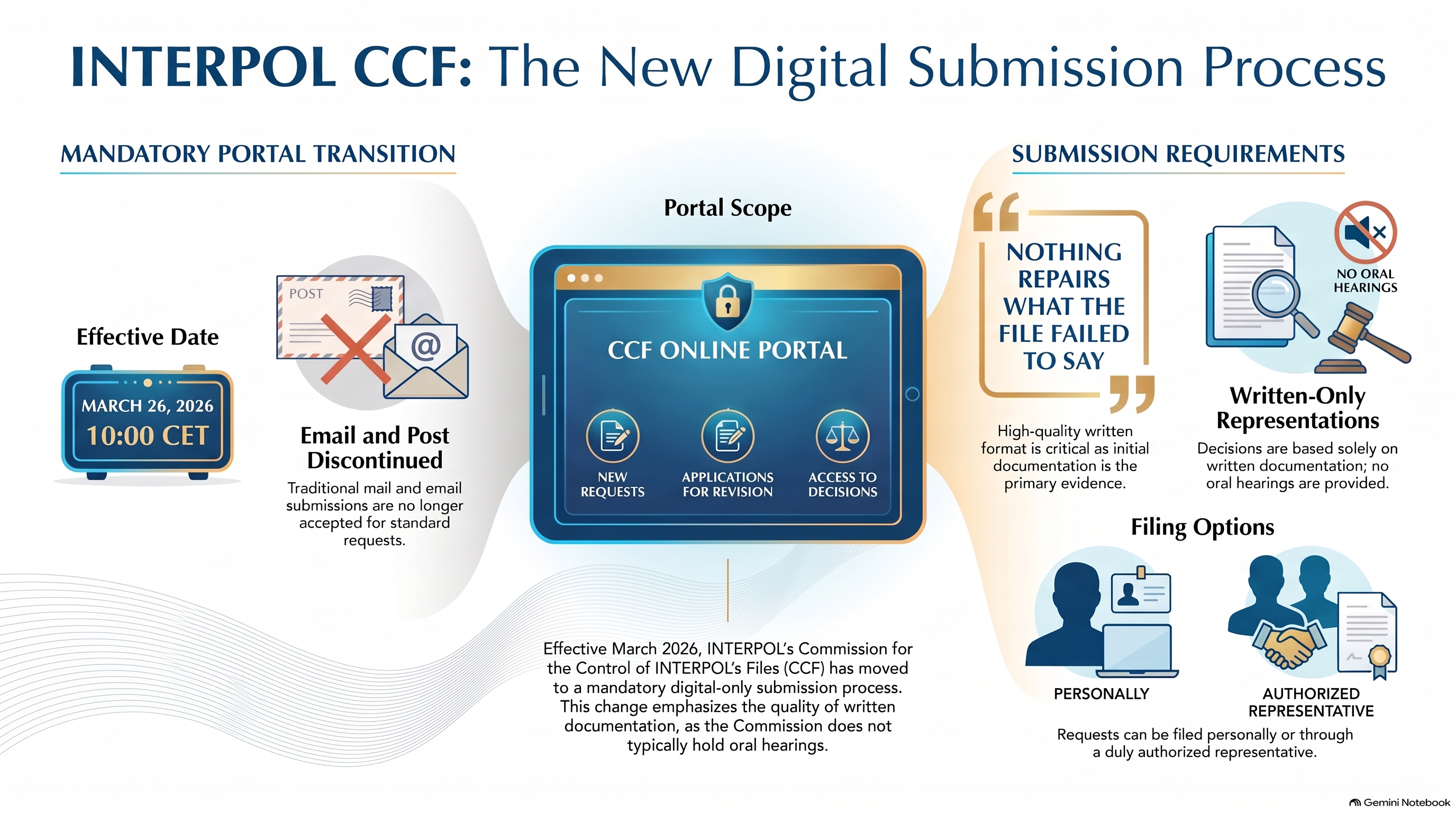
Through the portal, and only through it. INTERPOL states that as of 10:00 CET on Thursday 26 March 2026, all requests must be submitted via the dedicated secure online portal, and that e-mail and postal submissions are no longer accepted unless the Commission finds exceptional circumstances requiring other means, as provided for in Rule 25(2) of the CCF Operating Rules. The portal also handles applications for revision and gives access to the decisions rendered.
Do I need a lawyer to file a request with the CCF?
INTERPOL's procedure allows a request to be filed by the applicant personally or by a duly authorized representative. What makes legal work valuable is the format: INTERPOL states that the Commission analyses and processes requests on the basis of written representations and documentation only, with no oral hearings except in exceptional circumstances. Nothing said later repairs what the file failed to say.
How long does the CCF take to decide on my request?
The clock runs from admissibility, not from filing. According to INTERPOL, the Commission decides a request for access within four months of the date it became admissible, and a request for correction or deletion within nine months. When a decision becomes final the CCF notifies the applicant within one month, and INTERPOL advises applicants to wait at least three months after the session that examined the request before enquiring about the outcome.
The two routes differ in what they deliver:
- Access request: you ask whether data concerning you are processed in INTERPOL's Information System; decided within four months of admissibility.
- Correction or deletion request: you challenge the compliance of data already identified; decided within nine months of admissibility, with one month for the General Secretariat to comment on the Commission's conclusions.
What are the strongest grounds for deleting an Interpol red notice?
Three families of argument carry the weight, and all three rest on INTERPOL's own texts rather than on the merits of the foreign accusation.
The first is Article 3 of INTERPOL's Constitution, which states that it is strictly forbidden for the Organization to undertake any intervention or activities of a political, military, religious or racial character.
The second is Article 83 of the Rules on the Processing of Data, which closes certain categories of offence to red notices altogether.
The third is data quality. Article 12 of INTERPOL's Rules on the Processing of Data, headed Quality, requires that data processed in the INTERPOL Information System be accurate, relevant, not excessive in relation to their purpose and up to date.
That is the provision engaged where the judicial order behind the notice no longer exists, where the proceedings in the requesting country have ended, or where the recorded facts do not match the file.
How does the CCF assess an Article 3 argument?
By weighing predominance, case by case. INTERPOL states that Article 3 arguments are evaluated by reviewing the predominance of political, military, religious or racial elements over the ordinary-law character of the crime, alongside General Assembly resolutions on terrorism and on serious international crimes. The elements examined include the nature of the offence and the underlying facts, the status of the persons concerned, the source of the information and the general context of the case.
Are there offences for which INTERPOL cannot issue a red notice at all?
Yes, and the categories are published. INTERPOL states that under Article 83 of the Rules on the Processing of Data red notices may be published only where the offence is a serious ordinary-law crime, and not for offences raising controversial issues relating to behavioural or cultural norms; offences relating to family or private matters; or offences originating from a violation of administrative rules or deriving from private disputes. Article 83 also sets a penalty threshold: at least two years of maximum deprivation of liberty where the person is sought for prosecution, and at least six months imposed or remaining to be served where the person is sought to serve a sentence.
That last proviso matters in business cases. The exception (unless the criminal activity is aimed at facilitating a serious crime or is suspected of being connected to organized crime) attaches to the third category alone, not to the other two. INTERPOL states that the General Secretariat maintains a non-exhaustive list of specific offences falling within these categories.
Will the CCF also stop the extradition case running in Brazil?
No, and INTERPOL says so in express terms. The Commission states that it is not a substitute for the judicial authorities responsible for assessing the appropriateness of extradition, that it confines its assessment to whether the request for cooperation through INTERPOL channels complies with the Organization's rules, and that it gives no opinion on extradition procedures and outcomes and is not competent to act with regard to national files or procedures.
In Brazil that second front is judicial. Under art. 90 of the Migration Law (Lei 13.445/2017), no extradition is granted without a prior ruling by the Federal Supreme Court (Supremo Tribunal Federal — STF) on its legality and merits, and no appeal lies against that decision. What Brazil checks before it surrenders anyone is settled in that proceeding, not in Lyon, and a case therefore runs on two tracks at once, each with its own file, deadlines and decision-maker.
What actually happens after the CCF orders deletion?
The notice is cancelled and every member country is told. INTERPOL states that where a notice or diffusion is assessed as no longer being in compliance with its Constitution and rules, it is cancelled, all member countries are informed of the decision, and they are requested to remove any information from national databases. INTERPOL adds that a weekly notification informs all countries of the CCF's deletion decisions, advising them to update their databases and not to use INTERPOL's channels in the matter, and that a certificate confirming the person is no longer subject to a red notice may be issued.
Removal from a given national system still depends on that country acting on the request, and INTERPOL is explicit on the limit: the country that requested the red notice may keep the person on its own domestic wanted list, and its police may use channels outside INTERPOL. The warrant behind the notice is a national act, revoked only by the authority that issued it.
Can I appeal a CCF decision?
There is no appeal, but there is revision. INTERPOL states that an application for revision may be made only on the discovery of a fact which would probably have led to a different conclusion had it been known when the request was processed, and that it must be filed within six months of that discovery under Article 42 of the CCF Statute. Repeating the same arguments fails: the Commission does not process a request that is essentially the same as one it has already examined and that contains no new facts justifying a revision.
This article is general legal information about INTERPOL's rules and Brazilian law. It is not advice on any particular case, and every situation depends on the applicable treaty, the file held by the requesting country and the facts.
Why removing a red notice from Brazil calls for counsel on both fronts
At Garrastazu Advogados, the Criminal Law practice led by Leticia Bittencourt Carvalho Bernardes files requests with the Commission for the Control of INTERPOL's Files, defends extradition proceedings before the Federal Supreme Court and works through the migration consequences that follow an international alert. With specialists across every field of law and remote service throughout Brazil and abroad, we are ready to read your file and tell you which front comes first. Talk to us.

Frequently Asked Questions
Does deletion by INTERPOL cancel the national arrest warrant?
No. Deletion concerns data held in INTERPOL's Information System. INTERPOL states that the country which requested the red notice may keep the person on its own domestic wanted list, and the warrant stands until that country's own authorities revoke it.
What is the difference between a red notice and a diffusion?
Both are reviewed by INTERPOL's Notices and Diffusions Task Force, a multilingual team of lawyers, police officers and operational specialists. The difference is timing: a red notice is published by the General Secretariat only after that review, while a wanted-person diffusion goes directly from one National Central Bureau to others and reaches them before the review concludes, flagged as not yet authorized.
Does being the subject of a red notice mean I have been found guilty?
Not where the person is sought for prosecution. INTERPOL states that such a person has not been convicted and should be considered innocent until proven guilty, and that only someone sought to serve a sentence has already been found guilty by a court in the requesting country.
Is my request to the CCF recorded in INTERPOL's files?
INTERPOL states that requests are not recorded in the INTERPOL Information System. Where a person is already the subject of data there, the existence of a request under study may be indicated in the file, without any communication of its content.
Can the CCF help with my visa or immigration case in Brazil?
No. INTERPOL states that the Commission does not assist with visa applications, does not issue certificates of good conduct and is not competent to assist applicants in immigration matters or national extradition proceedings, nor to determine whether a person may travel abroad without fear of being arrested.
What can I do if I am threatened because I filed a request with the CCF?
INTERPOL states that Article 28(3) of the CCF Statute allows the Requests Chamber to take appropriate measures where it identifies abusive, improper or bad-faith conduct, including bringing reported acts of intimidation, coercion or reprisal to the attention of INTERPOL's bodies, subject to confidentiality requirements.
Content reviewed in September 2026, based on INTERPOL's rules and the Brazilian legislation in force.



Fique por dentro das nossas novidades.
Acompanhe nosso blog e nossas redes sociais.